|
This story was published in Radio Recall, the journal of the Metropolitan Washington Old-Time Radio Club, published six times per year.
Click here to return to the index of selected articles.
|
|
From The Shadow and His Competition to a Stripper:
 Guest Detectives on QUICK AS A FLASH Guest Detectives on QUICK AS A FLASH
by Karl Schadow, © 2005
(From Radio Recall, December 2005)
That novel quiz program with the mystery twist, Quick As A Flash, debuted over the Mutual network Sunday, July 16, 1944. Created by director Richard Lewis and emcee Ken Roberts, the program offered listeners thirty minutes of fast-paced entertainment. Along with Lewis, the program was produced by Bernard Prockter with scripts penned by Gene Wang. Six contestants chosen from the studio audience competed for cash and other prizes sponsored by the Helbros Watch Company. Historical events, movies, works of literature and famous situations were dramatized in short skits or by musical selections conducted by Ray Bloch and the Helbros Orchestra. The highlight of each program was the Helbros Derby which featured a guest detective from one of radio's mystery programs. However, radio sleuths were not the only invitees, as this survey will reveal of the more than fifty who participated during the seven year run of the program.
 Radio Sleuths Radio Sleuths
In the initial broadcast, Jay Jostyn was featured as Mr. District Attorney, who, over the next several years made an annual visit. Many other officials were invited. Warden Lewis E. Lawes presented dramas of his criminal cases. Former NYPD Commissioner Lewis J. Valentine in his role of Gangbuster's narrator was featured on the episode of December 2, 1945. The Sheriff, as portrayed by Robert Haag, then later by Don Briggs, was a regular on the program appearing at least fourteen times.
That master of accents and disguises, Karl Swenson as Mr. Chameleon made numerous performances. Dr. Benjamin Ordway (Everett Sloan and House Jameson) presented trials from the Crime Doctor series. Conversely, Scotland Yard's Inspector Burke (Basil Rathbone) hosted only one whodunit. Of interest is that Burke appeared a mere ten days following the start of his own Mutual program on January 21, 1947. It seems that the Network was seeking additional publicity for one of its own programs. Along with the guest fee, publicity was one of the benefits of being a guest.
Several other sleuths also made just one appearance. On the program of September 17, 1944, Raymond (of Inner Sanctum) displayed his horrific wit. Did CBS allow him to bring the creaking door, or were the Mutual soundmen charged with a most difficult task of creating a duplicate? Before portraying Mark Chase, Don Briggs played that revered attorney, Perry Mason in his lone appearance on April 21, 1946. In the milestone 100th episode of December 8, 1946, Hercule Poirot (Harold Huber) voiced his sole escapade. Richard Keith was cast as Special Investigator Frank Brock and also as True Detective Mysteries Editor John Shuttleworth on the programs of April 13, 1947 and May 23, 1948, respectively.
Nero Wolfe (Luis van Rooten) and Peter Salem (Santos Ortego) were two additional sleuths whose tenure was limited to a single performance. Victor Jory from radio's Matinee Theatre was cast as "Casanova" in the episode of October 22, 1944. It's currently unknown why certain characters only appeared once. A scheduling conflict among programs was the "case" for David Harding-Counterspy, who, during the 1944-45 and 1945-46 seasons appeared on at least six occasions. In the fall of 1946, his program was slotted directly opposite Quick As A Flash at 5:30 p.m. When ABC juggled the schedule for the 1948-49 season, not only did Don MacLaughlin return to being a regular, he delighted all associated with the program by bringing back many listeners that had left with him.
Two members of the "Press" who appeared often were Casey-Crime Photographer (Staats Cotsworth) of the Morning Express, and the editor of Big Town's Illustrated Press, Steve Wilson (Ed Pawley). A "host" of many a Helbros Derby was Geoffrey Barnes (Roc Rogers followed by Bernard Lenrow) of Mystery Theatre.
As a group, private eyes, both amateurs and those on the professional side were featured most frequently lead by the grandfather of them all, Nick Carter (Lon Clark). Other notables included: Mr. Keen (Bennett Kilpack), Charlie Chan (Ed Begley and Santos Ortega), Sidney Smith as Ellery Queen, Boston Blackie (Dick Kollmar) and Jack Scott Smart as The Fat Man. The Falcon was portrayed by three actors: James Meighan, Les Tremayne and Les Damon. Arguably, the character most associated with the program was The Shadow. During the initial season of 1944-45, John Archer portrayed this illustrious crime fighter nearly once a month, including the episode of May 20, 1945 after the network run of his program had ended for the season.
However, The Shadow would continue to be heard throughout the summer on many stations across the country (and abroad) via transcription. Moreover, The Shadow was a favorite of emcee Ken Roberts who had been an announcer on that program for over a decade. The program of March 16, 1947 (courtesy of Jack French) is one of two extant episodes and features The Shadow (Bret Morrison) in "Murder Is A Deadly Mistake." In this tale, a switchboard operator's error sets Lamont Cranston on the trail of a blackmailer. Margo Lane does not appear in the skit. It's unknown if other side-kicks or assistants appeared with the main honoree.
Guest duos did however, play various roles on Quick As A Flash as husband and wife teams. The Norths appeared more than a dozen times. According to the script of April 6, 1946 (provided by Nathan Berman), Pam and Jerry North discover a corpse in a phone booth in "The Compass Points To Murder." At the close of the program announcer Cy Harrice states that "... Alice Frost and Joseph Curtain may be heard as Mr. & Mrs. North on the Woodbury program." There is no mention of day or time, and certainly not of rival network NBC. This was in stark contrast to The Shadow which immediately preceded Quick As A Flash on Mutual and was, naturally, the recipient of more publicity than any other program.
| Other husband and wife teams were Nick and Nora Charles of The Thin Man series and Pat and Jean Abbott of The Abbott Mysteries. This latter program was a replacement for Quick As A Flash during the summers of 1945, 1946 and 1947. The Abbotts appeared on the final episode of each of these seasons as a lead-in to their own program which commenced the following Sunday and was also sponsored by Helbros. The duo of Barry Wood and Patsy Kelly from the Palmolive Party, a musical variety program were the guests on January 14, 1945. |
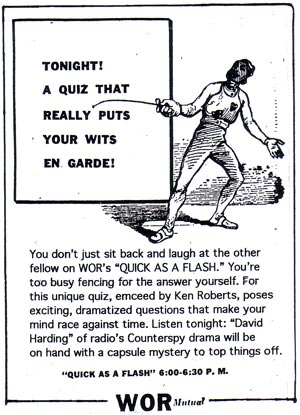
Reprinted from the 11-26-44 issue of The New York Herald-Tribune. Copyright 1944 Buckley Brodcasting Corp. Used with permission. |
Stage & Screen Stars
Although few in number as conveyed by Ken Roberts in his introduction of Hollywood actress Martha Vickers, the ladies earned well-deserved appearances, as is evident from the program of March 9, 1947. In this other extant program (courtesy of Jack French), Miss Vickers presents "The Case Of The Dangling Man" as investigated by private detective Phyllis Marlon. A take-off of Philip Marlowe, perhaps? However, Raymond Chandler's hard-boiled character would not begin his first radio series for three months. Miss Vickers does not precisely reveal the origin of the lavish Miss Marlon. Of course at the close of the program, listeners were encouraged to see Martha in her latest Warner Bros. release, "That Way With Women."
Detect and Collect co-host Wendy Barrie was the guest on the program of February 22, 1948. Arlene Francis had the distinction of the longest interval between performances. Her role as Ann Scotland on October 22, 1949 was almost five years later than the appearance as herself of December 10, 1944. The most infamous femme guest was Gypsy Rose Lee. In a recent telephone interview, Ken Roberts informed this author that in order to appear on the program, one had to "qualify" as a detective. And what were Miss Lee's qualifications? She had written a book entitled, "The G-String Murder" (ghost-authored by Craig Rice) and was present to promote her tome. Gypsy Rose Lee appeared on the December 23, 1945 Christmas program and each year prize money went to various charities for children. One can only imagine the sexual innuendoes that must have been downplayed in this particular episode.
Other sleuths on Christmas programs included: Mr. Keen, Superman, The Fat Man and sports legends Joe Louis and Jackie Robinson. Not to be outdone by boxing or baseball, the realm of football was represented with a puzzling whodunit by Bill Stern on November 10, 1946. During the previous month Milton Berle had entertained listeners who may have heard him as the judge from his program Kiss and Make Up. Many other entertainers were featured including: Bela Lugosi, William Eythe, John Loder, Jackie Cooper, Walter Abel, and Kirk Douglas.
Even the critics warranted an invitation when New York Post "Salon" Columnist Earl Wilson portrayed a nightclub reporter on the program of September 29, 1946. In his column the following day, Wilson remarked that he wasn't going to wait for the reviews and proclaimed a superb performance on the program, revealing that this was his first straight, dramatic role on radio. Wilson was no stranger to the medium though, as he had hosted a gossip program on Mutual in 1945. Wilson and many of the other personalities cited above had previously been guest armchair detectives on Ellery Queen. Did this "qualify" them for Quick As A Flash? Until additional recordings are located, once can only speculate on such assumptions.
On Monday, December 12, 1949 Quick As A Flash became a daily program on ABC with Bill Cullen as emcee. Cullen took over these duties from Win Elliott who had served in this capacity since September 1947. Guest detectives appeared each day for the entire week with Gene
Raymond starring the first week as The Amazing Mr. Malone. More than a dozen other sleuths were rotated periodically during the next nineteen months under the sponsorship of Quaker Oats, various Toni products and Block Drugs. These sleuths included: The Shadow, Casey-Crime Photographer, Nick Carter, Mr. District Attorney, The Falcon, Mr. & Mrs. North, David Harding-Counterspy, The Sheriff, Boston Blackie and Superman. Newcomers to this group were: Philo Vance (Jackson Beck), Gregory Hood (George Petrie), Hannibal Cobb (Santos Ortega) and the previously mentioned Mr. Malone. |
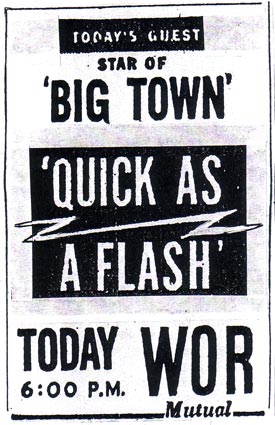
Reprinted from the 11-12-44 issue of The New York Herald-Tribune. Copyright 1944 Buckley Broadcasting Corp. Used with Permission. |
As this article goes to press, Bill McMahon of the Radio and Television Museum in Bowie, Maryland has some great news for fans of Quick As A Flash. Transcriptions of several episodes sponsored by the Block Drug Company have been donated to this institution. Within the next few months, researchers visiting this facility will have the pleasure of listening to these episodes. Additional information may be obtained by perusing the Museum's website at www.radiohistory.org. Readers of RADIO RECALL can look forward to a future article about this collection.
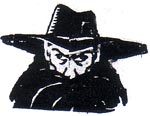
The illustration of The Shadow (original artwork) is copyright 1932 Street & Smith Publications, Inc. The Shadow character, copyright and trademarks are owned The Conde Nast Publications, Inc. Used with permission.
Author Karl Schadow is a MWOTRC member in Virginia, an expert on his "namesake," and a superb OTR researcher respected by radio historians.
|