|

This story was published in Radio Recall, the journal of the Metropolitan Washington Old-Time Radio Club, published six times per year.
Click here to return to the index of selected articles.
|
|
TOM SWIFT - A RADIO MYSTERY
by Maury Cagle, © 2005
(From Radio Recall, June 2005)
Many heroes moved from print to radio. Why didn’t Tom Swift?
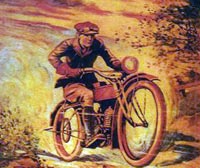 When I was six, I was given the best birthday gift I ever received---and maybe the best present ever. It was a small Zenith table model radio with five push buttons, in a brown Bakelite case. It was February, 1940, in Mobile, Alabama. Not only did my father come home from the Weather Bureau at lunch to present it to me, but he had arranged for the noon community bulletin board show on a local station to mark the occasion. Dad tuned in the radio and soon the announcer said: “And Happy Birthday to Maury Cagle and hello to his dog, Fresser (my dachshund).” Talk about the power of radio! I became a life-long true believer in that instant. When I was six, I was given the best birthday gift I ever received---and maybe the best present ever. It was a small Zenith table model radio with five push buttons, in a brown Bakelite case. It was February, 1940, in Mobile, Alabama. Not only did my father come home from the Weather Bureau at lunch to present it to me, but he had arranged for the noon community bulletin board show on a local station to mark the occasion. Dad tuned in the radio and soon the announcer said: “And Happy Birthday to Maury Cagle and hello to his dog, Fresser (my dachshund).” Talk about the power of radio! I became a life-long true believer in that instant.
Until I went away to college, I used that radio to carry me all over the world, from jungles to deserts, to make me laugh, and, if nothing else was on, eavesdrop on the troubled lives of soap opera characters and listen to dance remotes by mediocre bands in the wee hours of the morning. The best, however, was the daily afternoon lineup of my favorite heroes, Hop Harrigan, Jack Armstrong, Superman, Captain Midnight, and Tom Mix.
Then, about age ten, a new window opened on my world. My father took me on one of his frequent trips to New York City, where he haunted the used book stores around 9th Street. He pointed out one in the series of books about the young inventor, Tom Swift, and said he had enjoyed them when he was a boy. I spent 15 cents to buy it and loved it. With the zeal that only 10-year olds can muster, I set myself the goal of collecting the whole series.
When the book store owners found I was serious in my goal, they started putting volumes aside for me, and bringing them out from under the counter when I next showed up. I finished the collection about 1950, and still have the whole 40-volume set.
So, who was Tom Swift? Briefly, he was nothing less than America’s premier inventor, and the dominating figure in boy’s adventure fiction for 30 years. He was a young genius who lived in Shopton, NY, who developed a dazzling series of inventions that were always just a few years ahead of their time While Tom was a genuine straight arrow, he was a worthy adversary to his enemies, who were always trying to steal his inventions for nefarious purposes. There was a definite formula to the books, often involving the climactic use of the invention in question to defeat the bad guys.
Tom Swift was the brainchild of a man whose name is not very well known, but who shaped the reading habits of America’s youngsters for decades. Edward Stratemeyer was himself not a great writer, but he was a talented plot generator and organizer. He was also a born marketer, and sensed an opportunity. Youngsters were hungry to read adventure fiction, but their parents didn’t want them to read the pulps and dime novels of the day. Solution: package the same kind of stories in low-priced, hard-cover editions, selling for 50 cents. Parents would be pleased to see their offspring reading hard cover “literature.”
The results were phenomenal. The demand was such that Stratemeyer developed a syndicate of writers, who turned out more than 800 titles, and sold tens of millions of books. Watching every detail, he would give one of his stable of writers a two-page plot outline, and edit the resulting 200-page manuscript. At one time, he had 31 different series going on simultaneously. He was, in effect, to print what Frank and Anne Hummert were some years later to radio. Perhaps he was their model.
Among others, his imagination came up with The Hardy Boys, Nancy Drew, The Bobbsey Twins, and The Rover Boys, as well as Tom Swift. In 1926, a survey by the American Library Association showed that 98 percent of boys and girls listed a Stratemeyer book as their favorite, with Tom Swift the most popular.
The Tom Swift books purportedly were written by “Victor Appleton.” Some experts think all but the last few were the work of a newspaper reporter named Howard Garis, who created the Uncle Wiggily series of children’s books. In all, there were 40 titles. It’s fairly clear that the first few books were modeled on the real-life exploits of one of America’s genuine aviation pioneers, the under-appreciated Glenn Curtiss.
Among his talents, Stratemeyer sensed young America’s infatuation with the technology that blossomed in the first decades of the 20th century. It’s important to note that the inventions in Tom Swift were on the horizon---not far-fetched fantasy. They gave a peek into the reader’s immediate future. Stratemeyer’s plots included such then cutting-edge topics as:
--Submarine Boat (1910)
--Sky Racer (1911)
--Electric Rifle (1911)
--Giant Cannon (1913)
--Electric Locomotive (1922)
--Circling the Globe (1927)
--Television Detector (1933)
Stratemeyer died in 1930, but his daughters kept the syndicate going until 1974. The last few titles in the original Tom Swift series edge into science fiction:
--Planet Stone (1935)
--Giant Telescope (1939) (Big Little Book)
--Magnetic Silencer (1941) (Big Little Book)
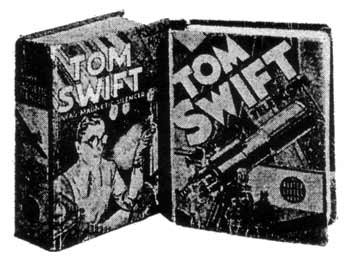
These two books appeared in dime-novel format in 1941 (left) and 1939.
While Tom Swift “retired” in 1941, his son, Tom Swift, Jr., was featured in his own series of 33 books, running from 1954 until 1971. These were far less realistic and featured fantastic inventions. Tom and his son still have loyal followings. Typing in “Tom Swift” in a Google search shows over two million entries.
I have often looked back on my beloved radio heroes and my Tom Swift collection and wandered: “Why wasn’t Tom on radio?” He seemed to be a natural. If you thumb through John Dunning’s “On The Air,” you’ll find many examples of shows which certainly did not have the name recognition, ample material or the rich development of characters of the Tom Swift series of books.
I have noticed that none of the Stratemeyer catalog of highly successful characters appeared on radio. There is not only no Tom Swift show, but none for the equally popular Bobbsey Twins, Nancy Drew, or the Hardy Boys. Was this a copyright problem? Why would it have been easier for many comic strip and comic book characters to jump to radio? Was it that Stratemeyer’s daughters feared that they could not control what happened to their characters if they moved to radio? Or were they already busy enough and just not interested? Or were they approached, and wanted too much money? We’ll never know.
I have a theory, unproved, that Stratemeyer’s formula for success --publish youth adventure in cheap hardcover editions -- while enormously successful in print, served to stop his wildly popular characters, such as Tom Swift, from making the transition to radio. Perhaps radio executives and advertisers were reluctant to put a “literary” figure such as Tom Swift on radio, since radio was much more closely associated with mass culture, such as the daily newspaper comics, comic books, and pulp magazines. It’s an ironic thought.
Whatever the cause, it was a great lost opportunity. Whenever I re-read one of my Tom Swift books, I hear it playing in my mind as if it were on that little Zenith radio I received so many years ago.
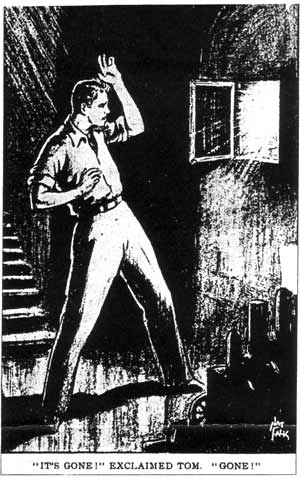
In Tom Swift and his Television Detector, from 1933,
the hero uses trademark techno-wizardry to foil crime.
(Author’s note: Further information on the topic may be found in John T. Dizer’s book, “Tom Swift & Company,” 1982, McFarland & Company; and in the following magazine articles: “Nancy Drew’s Father,” by Meghan O’Rourke, The New Yorker, November 8, 2004; and “The Perfect Inventor,” by Earl Swift, Invention & Technology, Fall 1990.)
|